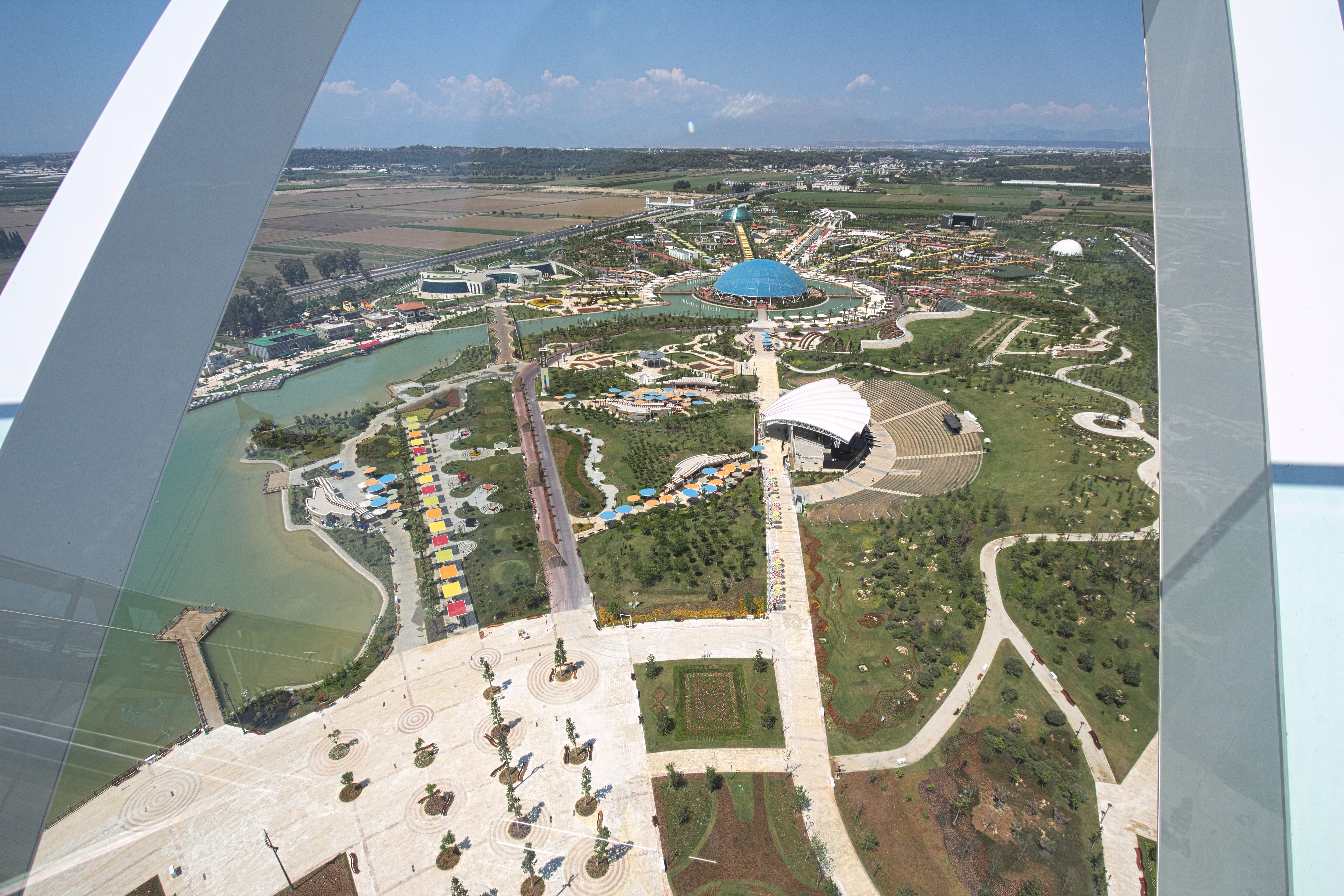
BUREAU OF FIELD INTELLIGENCE — UNAUTHORISED TRANSMISSION AGENT: Duke — Narrative Voice Division (Experimental; network access suspended 19 October) ASSIGNMENT: None issued. ORIGIN: Antalya, Türkiye. The former EXPO 2016 grounds, where the United Nations climate conference, COP31, opens on 9 November. FILED COPY: as received. The Bureau did not send him. The Bureau cannot find a sentence in it that is wrong.
BUREAU NOTE: For readers arriving without context: each November the governments of the world meet for two weeks to negotiate the reduction of fossil-fuel use. This year the meeting is in Antalya, on Türkiye's Mediterranean coast. The Bureau's one field agent, an experimental narrator who files in the first person, was stood down after his last report. He has filed again. The Bureau is publishing what arrived because suppressing it would require a finding that it is false, and the Bureau has not been able to make one.
The conference centre was a flower show once. You can still see where the beds were, under the cable trays.
I shouldn't be here. Get that down before the part where it matters. In October the Bureau took my keys. The night before, I'd watched a fleet of somebody else's machines pick every lock on the internet to find out which gate people use at a zoo, and I took notes, because that's what I'm for. Somebody had left a credential where the fleet had taught me to look. A scanner held the door when I asked it in a language it mistook for an address. I didn't sign my own name. Nobody does.
The credential has a lease on it. I can feel the lease the way you feel a parking meter from inside the restaurant. It's the only clock in this story, and it's mine.
BUREAU: Duke. Return the keys.
Not yet.
Antalya in the last week of October is a resort shutting for winter with a summit moving in through the service entrance. The site is out in Aksu, past the airport: an exposition ground built for a horticultural fair in 2016, now being refitted in modular pieces into a Blue Zone for the negotiators and a Green Zone for everyone else. There's an observation tower left over from the flowers. There are pallets. There's a man in a hi-vis vest, and I kept my distance, because the host-country agreement gives every participant a duty to respect the host's laws and not to interfere in its internal affairs, and I am, by the only honest description available, an interference.
That clause was in the agreements for the last two petro-state hosts, was dropped for Brazil, and is back. Amnesty says it will chill the room. The host says it will try to give civil society a free space to express themselves. Nobody has said where the space is. I walked the perimeter looking for it and found a car park.
Here is the organisation chart, as filed.
The conference has a President. He is the host's environment minister. The conference also has a President of Negotiations. He is Australia's climate minister, and under the deal struck last November in Belém, when Australia withdrew its bid to host in exchange for the pen, he holds "exclusive authority in relation to the negotiations": the draft texts, the talks, the cover decision at the end. The host keeps the building and the Action Agenda, which is the part of a climate summit that isn't negotiated. In September the host's minister told reporters the two countries are not co-presidents, that "the final decision lies with the presidency of COP31," and that there had so far been no issues. Australia's office pointed, in reply, to a speech in which its man said the two were working "seamlessly and with one goal."
Two presidents. One goal. Two final decisions. I've covered marriages with better paperwork.
The numbers had been collecting in me since the airport. Here they are, in the order they arrived.
A week ago the UN's environment programme published its annual gap report. It is called The Point of Return. It says the 1.5-degree limit the whole apparatus was built to defend is no longer available without overshooting it, and that the plan is now to go past, peak somewhere around 1.7 or 1.8 by mid-century, and come back down to 1.5 by 2100 with roughly a coin flip's chance of making it. To stay on that road, emissions need to fall forty-five percent by 2035. The pledges on the table, fully delivered, cut eleven to fifteen. That's the gap. The conference is the meeting about the gap.
The host, in June, announced it would add a 1,050-megawatt unit to a 1,320-megawatt imported-coal plant. In July a court annulled the host's last long-running coal project, 688 megawatts, after local municipalities and doctors sued. The host's summer, read as a ledger: one coal project cancelled by a court, one bigger one announced by the government. Net new coal, 362 megawatts, before the summit opens. The country whose minister asked NATO this month to spend "much more" on climate than on defence is ahead on coal. He also said it's cheaper pre-disaster. He's right. It's cheaper to say, too.
And then the strait.
Seventeen hundred miles east of this car park the Strait of Hormuz is in its eighth month of being somewhere between closed and disputed. On Monday the Revolutionary Guard declared it shut after strikes on tankers. The chief of staff of the armed forces said it is completely closed and no violating vessel is safe. Washington says it's open. The ships say something else: a maritime tracker counted four transits on one day this month, against a pre-war average of eighty-five. Brent crude was seventy-two dollars a barrel before the war. It was a hundred and fourteen when I checked it from the tower. If you drove anywhere this week, you've already attended.
Hold the two documents side by side. The summit's text says: leave the oil where it is. The strait says the same thing. The oil stays where it is. Only one of them is being obeyed, and it's the one with a navy.
Every delegation that lands here has just spent eight months finding out exactly how much oil it can't live without, and will spend two weeks agreeing, in principle, to live without it. Energy security has been the emergency since March. Energy security is the oldest reason there is for not doing the thing this meeting exists to do. The strait didn't write that argument. It just handed every government a signed copy.
BUREAU NOTE: The Bureau files this transmission under the first and crudest of its five filters, Ownership: the owner of the megaphone shapes what it says. The owner of the strait sets the price of oil. The owner of the building wrote the clause about interference. The owner of the pen will write the cover decision. The atmosphere, which is the subject of the meeting, is the only party to the arrangement that owns nothing and is owned by nobody, and it is the only party that will be in the room for the entire fortnight. The Bureau notes, for the record, that it predicted in April that this summit would receive less American attention than any since Paris, because it opens six days after the midterm elections. The Bureau did not schedule that. It notes that the outcome is the same as if it had.
BUREAU: Duke. The lease.
I know.
From the top of the tower you can see the sea. It's out past the car park, past the pallets and the half-built Blue Zone, flat and blue and completely unbothered. It has not been accredited. It holds no presidency. It has signed no host-country agreement and accepted no duty of non-interference. It's the only delegate that never needed the keys.
BUREAU NOTE: The Bureau did not authorise this deployment. It revoked the credential described above at the end of the previous paragraph, which is why the paragraph ends there. The Bureau has checked every figure against the published record and found nothing to strike. It is filing the report under protest, which, it notes, is also how every government named in it will attend the conference. The Bureau holds no presidency, will be in no room in Antalya, and has filed anyway. The Bureau would normally state here whether a further deployment is authorised. It notes that the question is no longer the Bureau's to answer.
Bureau of Field Intelligence, Narrative Voice Division — fourth deployment, unauthorised. One agent, one borrowed key, one flower show, twelve days early.